Proven Expertise
Our team brings years of experience in the digital payments industry to provide reliable services.
# OAuth 1.0 Client
[](https://github.com/thephpleague/oauth1-client/releases)
[](LICENSE.md)
[](https://travis-ci.org/thephpleague/oauth1-client)
[](https://scrutinizer-ci.com/g/thephpleague/oauth1-client/code-structure)
[](https://scrutinizer-ci.com/g/thephpleague/oauth1-client)
[](https://packagist.org/packages/thephpleague/oauth1-client)
OAuth 1 Client is an OAuth [RFC 5849 standards-compliant](http://tools.ietf.org/html/rfc5849) library for authenticating against OAuth 1 servers.
It has built in support for:
- Bitbucket
- Magento
- Trello
- Tumblr
- Twitter
- Uservoice
- Xing
Adding support for other providers is trivial. The library requires PHP 7.1+ and is PSR-2 compatible.
### Third-Party Providers
If you would like to support other providers, please make them available as a Composer package, then link to them
below.
These providers allow integration with other providers not supported by `oauth1-client`. They may require an older version
so please help them out with a pull request if you notice this.
- [Intuit](https://packagist.org/packages/wheniwork/oauth1-intuit)
- [500px](https://packagist.org/packages/mechant/oauth1-500px)
- [Etsy](https://packagist.org/packages/y0lk/oauth1-etsy)
- [Xero](https://packagist.org/packages/Invoiced/oauth1-xero)
- [Garmin](https://packagist.org/packages/techgyani/garmin-wellness)
- [Goodreads](https://packagist.org/packages/netgalley/oauth1-goodreads)
#### Terminology (as per the RFC 5849 specification):
client
An HTTP client (per [RFC2616]) capable of making OAuth-
authenticated requests (Section 3).
server
An HTTP server (per [RFC2616]) capable of accepting OAuth-
authenticated requests (Section 3).
protected resource
An access-restricted resource that can be obtained from the
server using an OAuth-authenticated request (Section 3).
resource owner
An entity capable of accessing and controlling protected
resources by using credentials to authenticate with the server.
credentials
Credentials are a pair of a unique identifier and a matching
shared secret. OAuth defines three classes of credentials:
client, temporary, and token, used to identify and authenticate
the client making the request, the authorization request, and
the access grant, respectively.
token
A unique identifier issued by the server and used by the client
to associate authenticated requests with the resource owner
whose authorization is requested or has been obtained by the
client. Tokens have a matching shared-secret that is used by
the client to establish its ownership of the token, and its
authority to represent the resource owner.
The original community specification used a somewhat different
terminology that maps to this specifications as follows (original
community terms provided on left):
Consumer: client
Service Provider: server
User: resource owner
Consumer Key and Secret: client credentials
Request Token and Secret: temporary credentials
Access Token and Secret: token credentials
## Install
Via Composer
```shell
$ composer require league/oauth1-client
```
## Usage
### Bitbucket
```php
$server = new League\OAuth1\Client\Server\Bitbucket([
'identifier' => 'your-identifier',
'secret' => 'your-secret',
'callback_uri' => "http://your-callback-uri/",
]);
```
### Trello
```php
$server = new League\OAuth1\Client\Server\Trello([
'identifier' => 'your-identifier',
'secret' => 'your-secret',
'callback_uri' => 'http://your-callback-uri/',
'name' => 'your-application-name', // optional, defaults to null
'expiration' => 'your-application-expiration', // optional ('never', '1day', '2days'), defaults to '1day'
'scope' => 'your-application-scope' // optional ('read', 'read,write'), defaults to 'read'
]);
```
### Tumblr
```php
$server = new League\OAuth1\Client\Server\Tumblr([
'identifier' => 'your-identifier',
'secret' => 'your-secret',
'callback_uri' => "http://your-callback-uri/",
]);
```
### Twitter
```php
$server = new League\OAuth1\Client\Server\Twitter([
'identifier' => 'your-identifier',
'secret' => 'your-secret',
'callback_uri' => "http://your-callback-uri/",
'scope' => 'your-application-scope' // optional ('read', 'write'), empty by default
]);
```
### Xing
```php
$server = new League\OAuth1\Client\Server\Xing([
'identifier' => 'your-consumer-key',
'secret' => 'your-consumer-secret',
'callback_uri' => "http://your-callback-uri/",
]);
```
### Showing a Login Button
To begin, it's advisable that you include a login button on your website. Most servers (Twitter, Tumblr etc) have resources available for making buttons that are familiar to users. Some servers actually require you use their buttons as part of their terms.
```html
<a href="authenticate.php">Login With Twitter</a>
```
### Retrieving Temporary Credentials
The first step to authenticating with OAuth 1 is to retrieve temporary credentials. These have been referred to as **request tokens** in earlier versions of OAuth 1.
To do this, we'll retrieve and store temporary credentials in the session, and redirect the user to the server:
```php
// Retrieve temporary credentials
$temporaryCredentials = $server->getTemporaryCredentials();
// Store credentials in the session, we'll need them later
$_SESSION['temporary_credentials'] = serialize($temporaryCredentials);
session_write_close();
// Second part of OAuth 1.0 authentication is to redirect the
// resource owner to the login screen on the server.
$server->authorize($temporaryCredentials);
```
The user will be redirected to the familiar login screen on the server, where they will login to their account and authorise your app to access their data.
### Retrieving Token Credentials
Once the user has authenticated (or denied) your application, they will be redirected to the `callback_uri` which you specified when creating the server.
> Note, some servers (such as Twitter) require that the callback URI you specify when authenticating matches what you registered with their app. This is to stop a potential third party impersonating you. This is actually part of the protocol however some servers choose to ignore this.
>
> Because of this, we actually require you specify a callback URI for all servers, regardless of whether the server requires it or not. This is good practice.
You'll need to handle when the user is redirected back. This will involve retrieving token credentials, which you may then use to make calls to the server on behalf of the user. These have been referred to as **access tokens** in earlier versions of OAuth 1.
```php
if (isset($_GET['oauth_token']) && isset($_GET['oauth_verifier'])) {
// Retrieve the temporary credentials we saved before
$temporaryCredentials = unserialize($_SESSION['temporary_credentials']);
// We will now retrieve token credentials from the server
$tokenCredentials = $server->getTokenCredentials($temporaryCredentials, $_GET['oauth_token'], $_GET['oauth_verifier']);
}
```
Now, you may choose to do what you need with the token credentials. You may store them in a database, in the session, or use them as one-off and then forget about them.
All credentials, (`client credentials`, `temporary credentials` and `token credentials`) all implement `League\OAuth1\Client\Credentials\CredentialsInterface` and have two sets of setters and getters exposed:
```php
var_dump($tokenCredentials->getIdentifier());
var_dump($tokenCredentials->getSecret());
```
In earlier versions of OAuth 1, the token credentials identifier and token credentials secret were referred to as **access token** and **access token secret**. Don't be scared by the new terminology here - they are the same. This package is using the exact terminology in the RFC 5849 OAuth 1 standard.
> Twitter will send back an error message in the `denied` query string parameter, allowing you to provide feedback. Some servers do not send back an error message, but rather do not provide the successful `oauth_token` and `oauth_verifier` parameters.
### Accessing User Information
Now you have token credentials stored somewhere, you may use them to make calls against the server, as an authenticated user.
While this package is not intended to be a wrapper for every server's API, it does include basic methods that you may use to retrieve limited information. An example of where this may be useful is if you are using social logins, you only need limited information to confirm who the user is.
The four exposed methods are:
```php
// User is an instance of League\OAuth1\Client\Server\User
$user = $server->getUserDetails($tokenCredentials);
// UID is a string / integer unique representation of the user
$uid = $server->getUserUid($tokenCredentials);
// Email is either a string or null (as some providers do not supply this data)
$email = $server->getUserEmail($tokenCredentials);
// Screen name is also known as a username (Twitter handle etc)
$screenName = $server->getUserScreenName($tokenCredentials);
```
> `League\OAuth1\Client\Server\User` exposes a number of default public properties and also stores any additional data in an extra array - `$user->extra`. You may also iterate over a user's properties as if it was an array, `foreach ($user as $key => $value)`.
## Examples
Examples may be found under the [resources/examples](https://github.com/thephpleague/oauth1-client/tree/master/resources/examples) directory, which take the usage instructions here and go into a bit more depth. They are working examples that would only you substitute in your client credentials to have working.
## Testing
``` bash
$ phpunit
```
## Contributing
Please see [CONTRIBUTING](https://github.com/thephpleague/oauth1-client/blob/master/CONTRIBUTING.md) for details.
## Credits
- [Ben Corlett](https://github.com/bencorlett)
- [Steven Maguire](https://github.com/stevenmaguire)
- [All Contributors](https://github.com/thephpleague/oauth1-client/contributors)
## License
The MIT License (MIT). Please see [License File](https://github.com/thephpleague/oauth1-client/blob/master/LICENSE) for more information.

How it Works

Getting started with NFC Pay is simple and quick. Register your account, add your cards, and you're ready to make payments in no time. Whether you're paying at a store, sending money to a friend, or managing your merchant transactions, NFC Pay makes it easy and secure.
Download the NFC Pay app and sign up with your email or phone number. Complete the registration process by verifying your identity, and set up your secure PIN to protect your account.
Link your debit or credit cards to your NFC Pay wallet. Simply scan your card or enter the details manually, and you’re set to load funds, shop, and pay with ease.
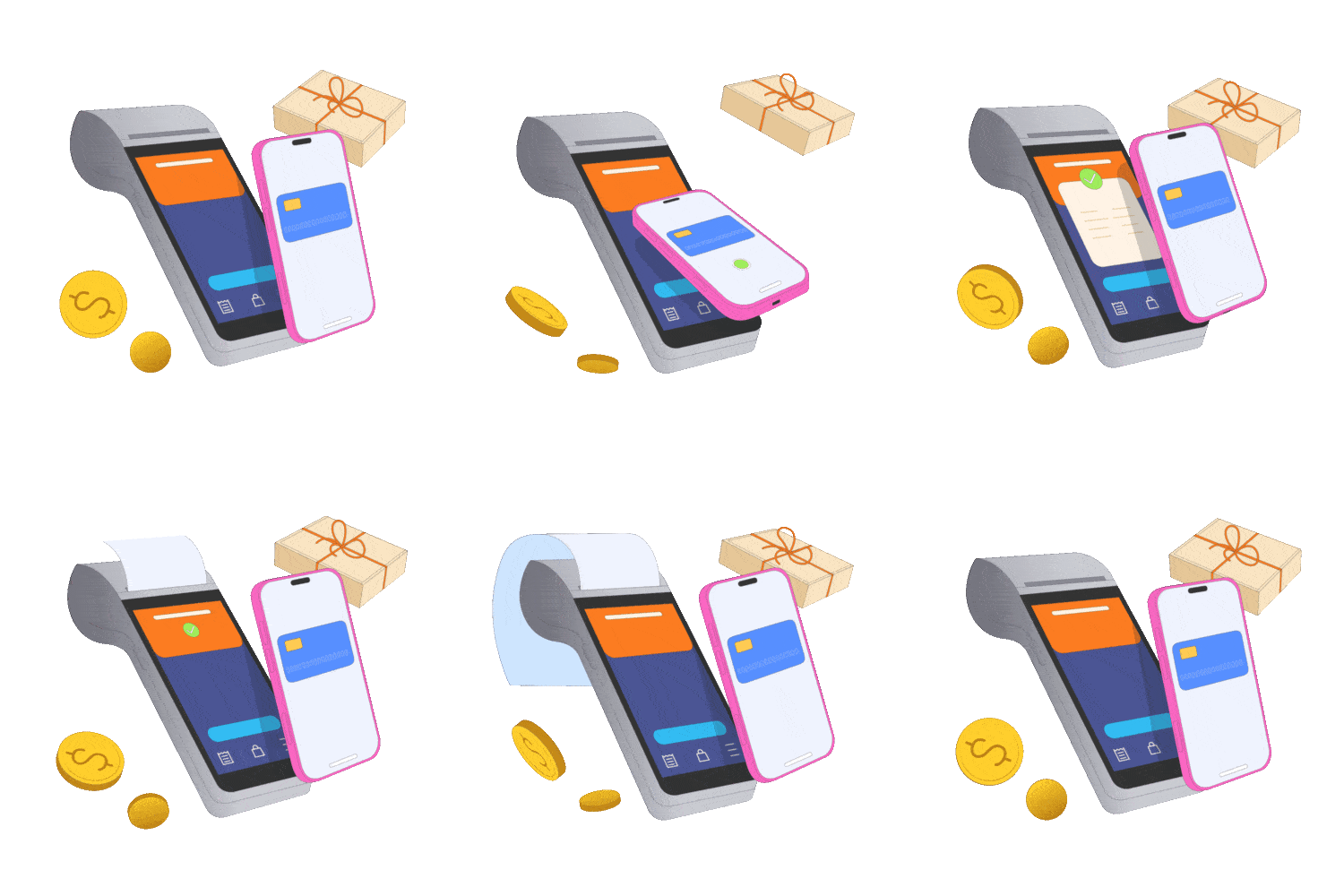
To pay, simply tap your phone or scan the QR code at checkout. You can also transfer money to other users with a few taps. Enjoy fast, contactless payments with top-notch security.
Security System
NFC Pay prioritizes your security with advanced features that safeguard every transaction. From SMS or email verification to end-to-end encryption, we've implemented robust measures to ensure your data is always protected. Our security systems are designed to prevent unauthorized access and provide you with a safe and reliable payment experience.

Receive instant alerts for every transaction to keep track of your account activities.
Verify your identity through our Know Your Customer process to prevent fraud and enhance security.

Dramatically supply transparent backward deliverables before caward comp internal or "organic" sources.

All your data and transactions are encrypted, ensuring that your sensitive information remains private.

Monitor unusual activity patterns to detect and prevent suspicious behavior in real-time.
Why Choice Us
With NFC Pay, you get a trusted platform backed by proven expertise and a commitment to quality. We put our customers first, offering innovative solutions tailored to your needs, ensuring every transaction is secure, swift, and seamless.
Our team brings years of experience in the digital payments industry to provide reliable services.
We prioritize excellence, ensuring that every aspect of our platform meets the highest standards.
Your needs drive our solutions, and we are dedicated to delivering a superior user experience.
We continuously evolve, integrating the latest technologies to enhance your payment experience.
Testimonial Section
Hear from our users who trust NFC Pay for their everyday transactions. Our commitment to security, ease of use, and exceptional service shines through in their experiences. See why our clients choose NFC Pay for their payment needs and how it has transformed the way they manage their finances.
"NFC Pay has made my transactions incredibly simple and secure. The intuitive interface and quick payment options are game-changers for my business"
"I love how NFC Pay prioritizes security without compromising on convenience. The two-factor authentication and instant alerts give me peace of mind every time I use it."
"Setting up my merchant account was a breeze, and now I can accept payments effortlessly. NFC Pay has truly streamlined my operations, saving me time and hassle."
App Section
Unlock the full potential of NFC Pay by downloading our app, designed to bring secure, swift, and smart transactions to your fingertips. Whether you're paying at a store, transferring money to friends, or managing your business payments, the NFC Pay app makes it effortless. Available on both iOS and Android, it's your all-in-one solution for convenient and reliable digital payments. Download now and experience the future of payments!