PHPMatrix
==========
---
PHP Class for handling Matrices
[](https://github.com/MarkBaker/PHPMatrix/actions)
[](https://packagist.org/packages/markbaker/matrix)
[](https://packagist.org/packages/markbaker/matrix)
[](https://packagist.org/packages/markbaker/matrix)
[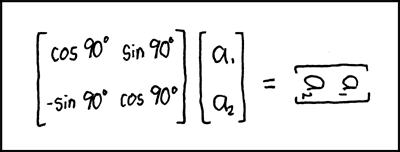](https://xkcd.com/184/)
Matrix Transform
---
This library currently provides the following operations:
- addition
- direct sum
- subtraction
- multiplication
- division (using [A].[B]<sup>-1</sup>)
- division by
- division into
together with functions for
- adjoint
- antidiagonal
- cofactors
- determinant
- diagonal
- identity
- inverse
- minors
- trace
- transpose
- solve
Given Matrices A and B, calculate X for A.X = B
and classes for
- Decomposition
- LU Decomposition with partial row pivoting,
such that [P].[A] = [L].[U] and [A] = [P]<sup>|</sup>.[L].[U]
- QR Decomposition
such that [A] = [Q].[R]
## TO DO
- power() function
- Decomposition
- Cholesky Decomposition
- EigenValue Decomposition
- EigenValues
- EigenVectors
---
# Installation
```shell
composer require markbaker/matrix:^3.0
```
# Important BC Note
If you've previously been using procedural calls to functions and operations using this library, then from version 3.0 you should use [MarkBaker/PHPMatrixFunctions](https://github.com/MarkBaker/PHPMatrixFunctions) instead (available on packagist as [markbaker/matrix-functions](https://packagist.org/packages/markbaker/matrix-functions)).
You'll need to replace `markbaker/matrix`in your `composer.json` file with the new library, but otherwise there should be no difference in the namespacing, or in the way that you have called the Matrix functions in the past, so no actual code changes are required.
```shell
composer require markbaker/matrix-functions:^1.0
```
You should not reference this library (`markbaker/matrix`) in your `composer.json`, composer wil take care of that for you.
# Usage
To create a new Matrix object, provide an array as the constructor argument
```php
$grid = [
[16, 3, 2, 13],
[ 5, 10, 11, 8],
[ 9, 6, 7, 12],
[ 4, 15, 14, 1],
];
$matrix = new Matrix\Matrix($grid);
```
The `Builder` class provides helper methods for creating specific matrices, specifically an identity matrix of a specified size; or a matrix of a specified dimensions, with every cell containing a set value.
```php
$matrix = Matrix\Builder::createFilledMatrix(1, 5, 3);
```
Will create a matrix of 5 rows and 3 columns, filled with a `1` in every cell; while
```php
$matrix = Matrix\Builder::createIdentityMatrix(3);
```
will create a 3x3 identity matrix.
Matrix objects are immutable: whenever you call a method or pass a grid to a function that returns a matrix value, a new Matrix object will be returned, and the original will remain unchanged. This also allows you to chain multiple methods as you would for a fluent interface (as long as they are methods that will return a Matrix result).
## Performing Mathematical Operations
To perform mathematical operations with Matrices, you can call the appropriate method against a matrix value, passing other values as arguments
```php
$matrix1 = new Matrix\Matrix([
[2, 7, 6],
[9, 5, 1],
[4, 3, 8],
]);
$matrix2 = new Matrix\Matrix([
[1, 2, 3],
[4, 5, 6],
[7, 8, 9],
]);
var_dump($matrix1->multiply($matrix2)->toArray());
```
or pass all values to the appropriate static method
```php
$matrix1 = new Matrix\Matrix([
[2, 7, 6],
[9, 5, 1],
[4, 3, 8],
]);
$matrix2 = new Matrix\Matrix([
[1, 2, 3],
[4, 5, 6],
[7, 8, 9],
]);
var_dump(Matrix\Operations::multiply($matrix1, $matrix2)->toArray());
```
You can pass in the arguments as Matrix objects, or as arrays.
If you want to perform the same operation against multiple values (e.g. to add three or more matrices), then you can pass multiple arguments to any of the operations.
## Using functions
When calling any of the available functions for a matrix value, you can either call the relevant method for the Matrix object
```php
$grid = [
[16, 3, 2, 13],
[ 5, 10, 11, 8],
[ 9, 6, 7, 12],
[ 4, 15, 14, 1],
];
$matrix = new Matrix\Matrix($grid);
echo $matrix->trace();
```
or you can call the static method, passing the Matrix object or array as an argument
```php
$grid = [
[16, 3, 2, 13],
[ 5, 10, 11, 8],
[ 9, 6, 7, 12],
[ 4, 15, 14, 1],
];
$matrix = new Matrix\Matrix($grid);
echo Matrix\Functions::trace($matrix);
```
```php
$grid = [
[16, 3, 2, 13],
[ 5, 10, 11, 8],
[ 9, 6, 7, 12],
[ 4, 15, 14, 1],
];
echo Matrix\Functions::trace($grid);
```
## Decomposition
The library also provides classes for matrix decomposition. You can access these using
```php
$grid = [
[1, 2],
[3, 4],
];
$matrix = new Matrix\Matrix($grid);
$decomposition = new Matrix\Decomposition\QR($matrix);
$Q = $decomposition->getQ();
$R = $decomposition->getR();
```
or alternatively us the `Decomposition` factory, identifying which form of decomposition you want to use
```php
$grid = [
[1, 2],
[3, 4],
];
$matrix = new Matrix\Matrix($grid);
$decomposition = Matrix\Decomposition\Decomposition::decomposition(Matrix\Decomposition\Decomposition::QR, $matrix);
$Q = $decomposition->getQ();
$R = $decomposition->getR();
```
Enhancing Payment Security: The Role of Encryption and Tokenization in Digital Transactions
As digital transactions proliferate, ensuring robust payment security is more critical than ever. Two foundational technologies that are pivotal in this effort are encryption and tokenization. Encryption is a process that transforms data into a secure format, known as ciphertext, which can only be deciphered using a specific decryption key. This means that even if data is intercepted during transmission, it remains unreadable and protected from unauthorized access. Encryption is essential in safeguarding sensitive payment information, such as credit card details and personal data, during online transactions. Tokenization, on the other hand, involves substituting sensitive data with unique identifiers or "tokens." These tokens serve as placeholders and have no value outside of the specific transaction context. If intercepted, tokens are meaningless and cannot be used to access the original sensitive data. This method significantly reduces the risk of fraud and data breaches, as the actual payment information is not stored or transmitted. Together, encryption and tokenization form a powerful security framework. Encryption ensures that data is protected during transmission, while tokenization minimizes the risk of exposing sensitive information by replacing it with secure, non-sensitive tokens. These technologies are integral to modern payment platforms, providing a robust defense against cyber threats. By implementing advanced encryption and tokenization techniques, businesses can enhance the security of digital transactions, ensuring that users' financial and personal information remains safe. This comprehensive approach not only builds user trust but also fortifies the overall security infrastructure of digital payment systems. As cyber threats evolve, the continued advancement of encryption and tokenization will be crucial in maintaining secure and reliable payment processes.
In the digital age, privacy concerns have become increasingly paramount, prompting the European Union to enact the General Data Protection Regulation (GDPR) in 2018. Among its many provisions, GDPR sets strict guidelines for the collection and processing of personal data, including the use of cookies on websites. Privacy Policy