## Debugbar for Laravel

[](http://choosealicense.com/licenses/mit/)
[](https://packagist.org/packages/barryvdh/laravel-debugbar)
[](https://packagist.org/packages/barryvdh/laravel-debugbar)
[](https://fruitcake.nl/)
This is a package to integrate [PHP Debug Bar](http://phpdebugbar.com/) with Laravel.
It includes a ServiceProvider to register the debugbar and attach it to the output. You can publish assets and configure it through Laravel.
It bootstraps some Collectors to work with Laravel and implements a couple custom DataCollectors, specific for Laravel.
It is configured to display Redirects and (jQuery) Ajax Requests. (Shown in a dropdown)
Read [the documentation](http://phpdebugbar.com/docs/) for more configuration options.
### Note: Use the DebugBar only in development. Do not use Debugbar on publicly accessible websites, as it will leak information from stored requests (by design). It can also slow the application down (because it has to gather data). So when experiencing slowness, try disabling some of the collectors.
This package includes some custom collectors:
- QueryCollector: Show all queries, including binding + timing
- RouteCollector: Show information about the current Route.
- ViewCollector: Show the currently loaded views. (Optionally: display the shared data)
- EventsCollector: Show all events
- LaravelCollector: Show the Laravel version and Environment. (disabled by default)
- SymfonyRequestCollector: replaces the RequestCollector with more information about the request/response
- LogsCollector: Show the latest log entries from the storage logs. (disabled by default)
- FilesCollector: Show the files that are included/required by PHP. (disabled by default)
- ConfigCollector: Display the values from the config files. (disabled by default)
- CacheCollector: Display all cache events. (disabled by default)
Bootstraps the following collectors for Laravel:
- LogCollector: Show all Log messages
- SymfonyMailCollector for Mail
And the default collectors:
- PhpInfoCollector
- MessagesCollector
- TimeDataCollector (With Booting and Application timing)
- MemoryCollector
- ExceptionsCollector
It also provides a facade interface (`Debugbar`) for easy logging Messages, Exceptions and Time
## Installation
Require this package with composer. It is recommended to only require the package for development.
```shell
composer require barryvdh/laravel-debugbar --dev
```
Laravel uses Package Auto-Discovery, so doesn't require you to manually add the ServiceProvider.
The Debugbar will be enabled when `APP_DEBUG` is `true`.
> If you use a catch-all/fallback route, make sure you load the Debugbar ServiceProvider before your own App ServiceProviders.
### Laravel without auto-discovery:
If you don't use auto-discovery, add the ServiceProvider to the providers array in config/app.php
```php
Barryvdh\Debugbar\ServiceProvider::class,
```
If you want to use the facade to log messages, add this to your facades in app.php:
```php
'Debugbar' => Barryvdh\Debugbar\Facades\Debugbar::class,
```
The profiler is enabled by default, if you have APP_DEBUG=true. You can override that in the config (`debugbar.enabled`) or by setting `DEBUGBAR_ENABLED` in your `.env`. See more options in `config/debugbar.php`
You can also set in your config if you want to include/exclude the vendor files also (FontAwesome, Highlight.js and jQuery). If you already use them in your site, set it to false.
You can also only display the js or css vendors, by setting it to 'js' or 'css'. (Highlight.js requires both css + js, so set to `true` for syntax highlighting)
#### Copy the package config to your local config with the publish command:
```shell
php artisan vendor:publish --provider="Barryvdh\Debugbar\ServiceProvider"
```
### Laravel with Octane:
Make sure to add LaravelDebugbar to your flush list in `config/octane.php`.
```php
'flush' => [
\Barryvdh\Debugbar\LaravelDebugbar::class,
],
```
### Lumen:
For Lumen, register a different Provider in `bootstrap/app.php`:
```php
if (env('APP_DEBUG')) {
$app->register(Barryvdh\Debugbar\LumenServiceProvider::class);
}
```
To change the configuration, copy the file to your config folder and enable it:
```php
$app->configure('debugbar');
```
## Usage
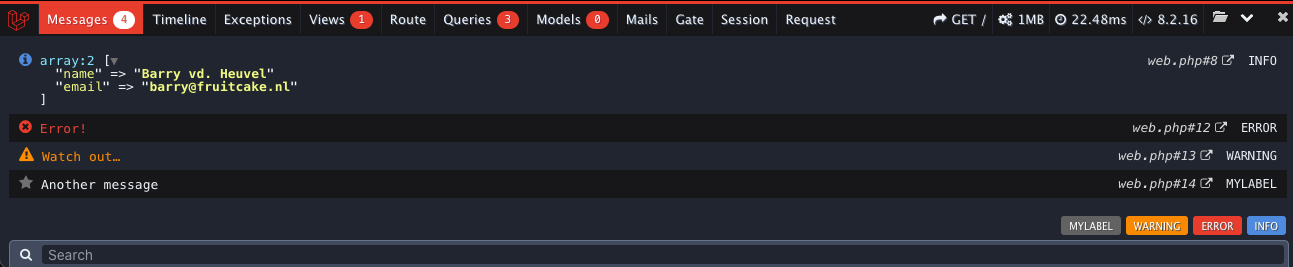
You can now add messages using the Facade (when added), using the PSR-3 levels (debug, info, notice, warning, error, critical, alert, emergency):
```php
Debugbar::info($object);
Debugbar::error('Error!');
Debugbar::warning('Watch out…');
Debugbar::addMessage('Another message', 'mylabel');
```
And start/stop timing:
```php
Debugbar::startMeasure('render','Time for rendering');
Debugbar::stopMeasure('render');
Debugbar::addMeasure('now', LARAVEL_START, microtime(true));
Debugbar::measure('My long operation', function() {
// Do something…
});
```
Or log exceptions:
```php
try {
throw new Exception('foobar');
} catch (Exception $e) {
Debugbar::addThrowable($e);
}
```
There are also helper functions available for the most common calls:
```php
// All arguments will be dumped as a debug message
debug($var1, $someString, $intValue, $object);
// `$collection->debug()` will return the collection and dump it as a debug message. Like `$collection->dump()`
collect([$var1, $someString])->debug();
start_measure('render','Time for rendering');
stop_measure('render');
add_measure('now', LARAVEL_START, microtime(true));
measure('My long operation', function() {
// Do something…
});
```
If you want you can add your own DataCollectors, through the Container or the Facade:
```php
Debugbar::addCollector(new DebugBar\DataCollector\MessagesCollector('my_messages'));
//Or via the App container:
$debugbar = App::make('debugbar');
$debugbar->addCollector(new DebugBar\DataCollector\MessagesCollector('my_messages'));
```
By default, the Debugbar is injected just before `</body>`. If you want to inject the Debugbar yourself,
set the config option 'inject' to false and use the renderer yourself and follow http://phpdebugbar.com/docs/rendering.html
```php
$renderer = Debugbar::getJavascriptRenderer();
```
Note: Not using the auto-inject, will disable the Request information, because that is added After the response.
You can add the default_request datacollector in the config as alternative.
## Enabling/Disabling on run time
You can enable or disable the debugbar during run time.
```php
\Debugbar::enable();
\Debugbar::disable();
```
NB. Once enabled, the collectors are added (and could produce extra overhead), so if you want to use the debugbar in production, disable in the config and only enable when needed.
## Storage
Debugbar remembers previous requests, which you can view using the Browse button on the right. This will only work if you enable `debugbar.storage.open` in the config.
Make sure you only do this on local development, because otherwise other people will be able to view previous requests.
In general, Debugbar should only be used locally or at least restricted by IP.
It's possible to pass a callback, which will receive the Request object, so you can determine access to the OpenHandler storage.
## Twig Integration
Laravel Debugbar comes with two Twig Extensions. These are tested with [rcrowe/TwigBridge](https://github.com/rcrowe/TwigBridge) 0.6.x
Add the following extensions to your TwigBridge config/extensions.php (or register the extensions manually)
```php
'Barryvdh\Debugbar\Twig\Extension\Debug',
'Barryvdh\Debugbar\Twig\Extension\Dump',
'Barryvdh\Debugbar\Twig\Extension\Stopwatch',
```
The Dump extension will replace the [dump function](http://twig.sensiolabs.org/doc/functions/dump.html) to output variables using the DataFormatter. The Debug extension adds a `debug()` function which passes variables to the Message Collector,
instead of showing it directly in the template. It dumps the arguments, or when empty; all context variables.
```twig
{{ debug() }}
{{ debug(user, categories) }}
```
The Stopwatch extension adds a [stopwatch tag](http://symfony.com/blog/new-in-symfony-2-4-a-stopwatch-tag-for-twig) similar to the one in Symfony/Silex Twigbridge.
```twig
{% stopwatch "foo" %}
…some things that gets timed
{% endstopwatch %}
```
The Future of Digital Wallets: How Mobile Payments are Shaping the Financial Landscape
Digital wallets have fundamentally transformed how we manage money, offering a streamlined, secure, and highly efficient method for handling payments and transactions. By consolidating credit, debit, and loyalty card information into a single app, digital wallets simplify the payment process and eliminate the need for physical cards, enhancing both convenience and security. As digital wallets evolve, they are integrating advanced features that push the boundaries of traditional payment methods. Biometric authentication, such as fingerprint and facial recognition, adds an extra layer of security, ensuring that only authorized users can access their payment information. Real-time transaction alerts provide instant notifications for every transaction, allowing users to monitor their spending and detect any unauthorized activity swiftly. Budgeting tools within digital wallets offer personalized insights and financial management capabilities, helping users track their expenses and plan their budgets more effectively. The growing adoption of digital wallets is fueled by their ease of use and the increasing demand for contactless payment solutions. As technology advances, digital wallets are likely to incorporate even more innovative features, such as artificial intelligence for personalized financial advice, integrated loyalty programs for seamless rewards management, and cross-border transaction capabilities for global shopping convenience. The integration of these features is reshaping the financial landscape by making transactions not only faster but also more secure and user-friendly. The future of digital wallets is set to further revolutionize how we handle our finances, offering an all-encompassing solution that caters to the evolving needs of modern consumers. As digital wallets continue to advance, they will play an increasingly central role in shaping the future of financial interactions, driving the global shift towards a more digital and cashless economy.
In the digital age, privacy concerns have become increasingly paramount, prompting the European Union to enact the General Data Protection Regulation (GDPR) in 2018. Among its many provisions, GDPR sets strict guidelines for the collection and processing of personal data, including the use of cookies on websites. Privacy Policy